oeuvre
How might we empower patients to make decisions about their own health?
What is it?
Product Overview
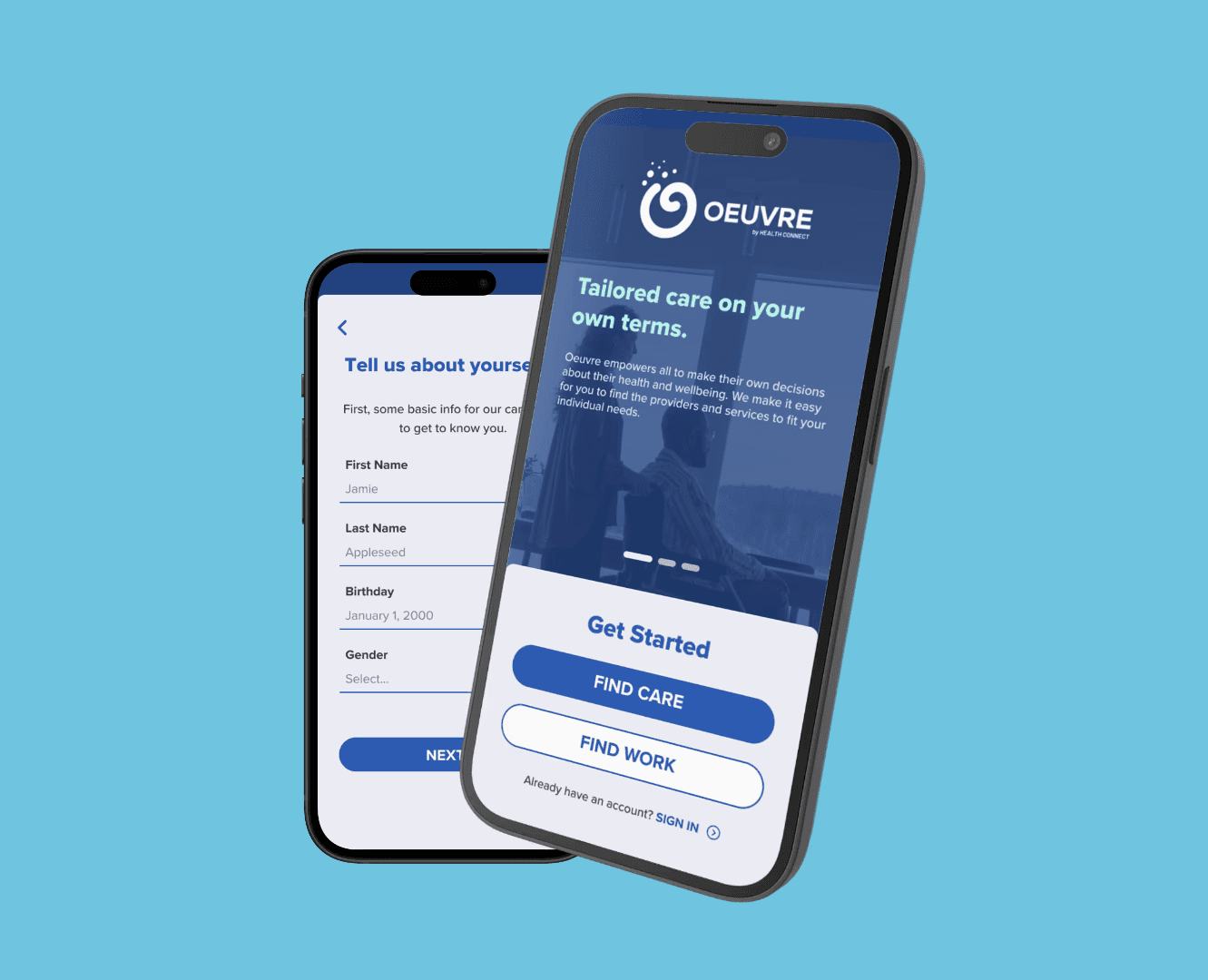
Oeuvre is a in-home care service platform that connects patients and their loved ones with high-quality care from a network of caregivers and home care aides. Oeuvre empowers people to make their own decisions regarding their health and wellbeing, making it easy for users to find the providers and services tailored to their own individual needs.
what did I do?
Roles & Responsibilities
I served as the Lead UX Researcher and Product Designer for the project. During my role, I was responsible for:
Conducting a usability study on the preliminary prototype.
Identifying pain points for the next iteration of the app.
Creating a high-fidelity prototype to pass off to our contracted app development team.
what did I use?
Tools
Figma
InVision
Techniques
Heuristic Evaluation
Field Studies
Wireframing
Prototyping
Who is it for?
Audience
Oeuvre was designed with patients and their loved ones in mind. Keeping in mind that many users requiring our services might not be the most comfortable using technology and might have varying degrees of mobility and cognition, we took special consideration to make sure the app adheres to web accessibility standards.
Oeuvre at its core is a double-pronged product with a client-facing side and a provider-facing side. In this project, the team focused on the client-facing side of the product in order to prioritize end users.
What's the problem?
The Story of Oeuvre
Prior to my tenure at Home Health Resource Group, Oeuvre was a shelved project put on hold by the global COVID-19 pandemic. Conceptualized by our CEO, the company contracted a third-party app development firm to create the first iteration of the application.
Upon my arrival, I expressed interest in enrolling the in-house software development team in the UX design process and implementing best practices within our projects. Intrigued by the benefits of UX research, I took ownership of the project to audit Oeuvre v1.0's usability before moving forward with next steps for the company.
Preliminary Heuristic Evaluation
To begin our discovery phase, my project manager and I collaborated to conduct a heuristic evaluation of the current iteration of Oeuvre. While a heuristic evaluation is not a replacement for observation-based user research, it enables us to quickly identify pain points in our product before proceeding with the discovery and ideation process.
Our team set our scope as a evaluating the product as clients booking an appointment through Oeuvre. After conducting our individual evaluations, my project manager and I touched base and identified three heuristics in particular that would be the most impactful to address in the next iteration of Oeuvre's design:
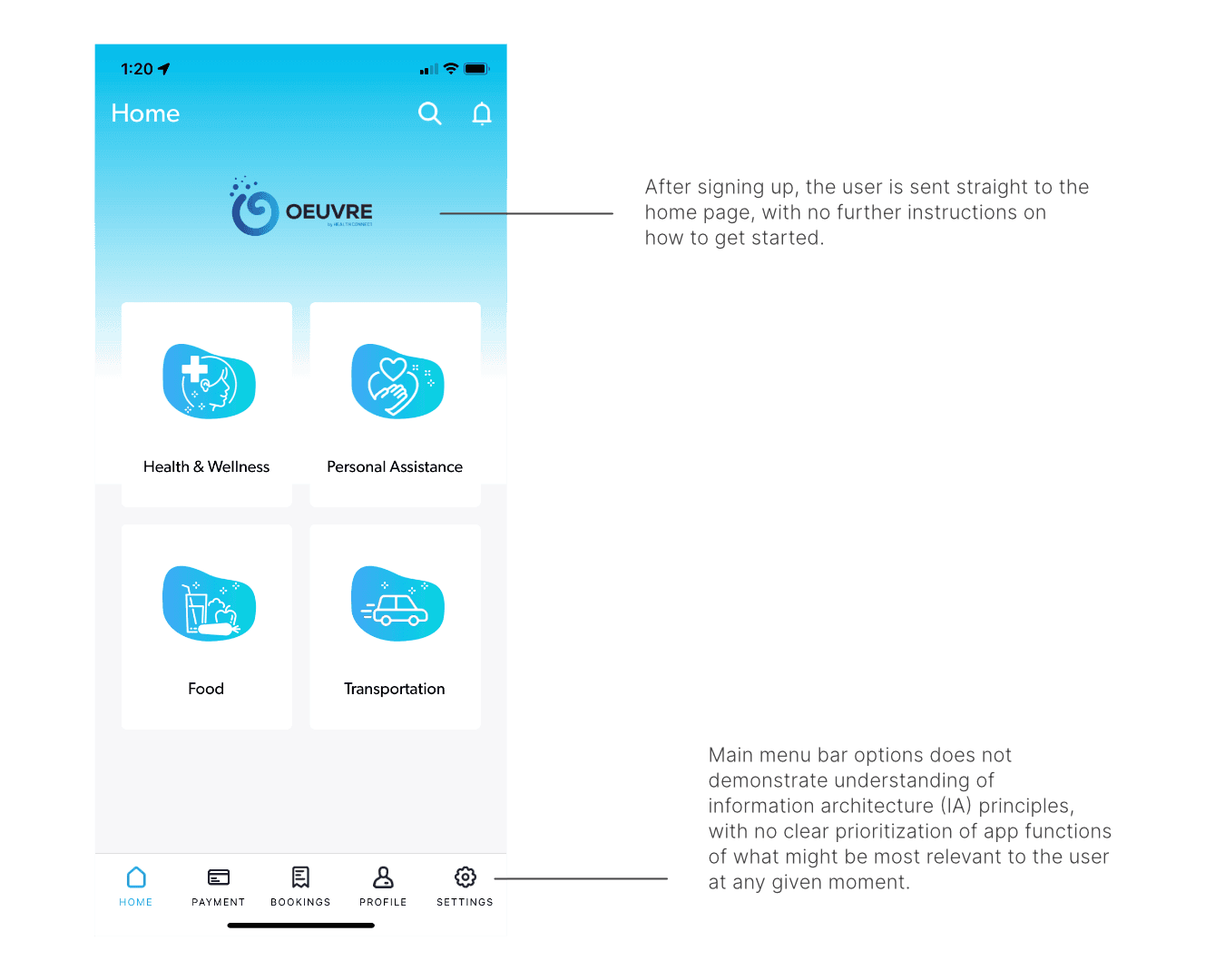
Help and Documentation: The lack of any user onboarding process immediately throws the user into the home screen without any product tour, tutorial, or assistance to get clients started.
Aesthetic and Minimalistic Design: The current design does not showcase the most relevant features to the client, with some main buttons better consolidated under reorganized pages.
Flexibility and Efficiency of Use: The design lacks any customization or personalization opportunities for the client; the client is not in choice of which services they want shown on the home screen for easy access.
Field Studies
In order to further explore the problem space, I coordinated field studies to better understand a client's attitude towards autonomy when it comes to their care. I also spoke with caregivers who provided insight on how they navigated the experience of having somebody that depends on them for care.
In collaboration with the company's Assisted Living Program Director, I visited one of our care homes to interview two clients. I asked them questions regarding their day-to-day life, which tasks they usually require assistance with, and how comfortable they are with technology and using it to receive care. Through these interviews, some common threads that popped up were:
The need for ease-of-use: Interviewees noted how ease of use is what keeps them coming back to their tablets and smartphones. They also noted frustration when they cannot get help with their devices or if the devices feel slow.
Frustration with caregiver availability: Clients demonstrated notable frustration with staffing availability, especially when they cannot receive the care they want when they need it the most.
The lack of confidence with technology: Both clients noted that they were intrigued by the concept of Oeuvre's business model, but expressed hesitation that they would not be able to use it correctly. One client in particular explained that they would most likely not use the app out of the fear that they would order the wrong services.

2025 — Keith Vega — Made with love and gratitude in California.